
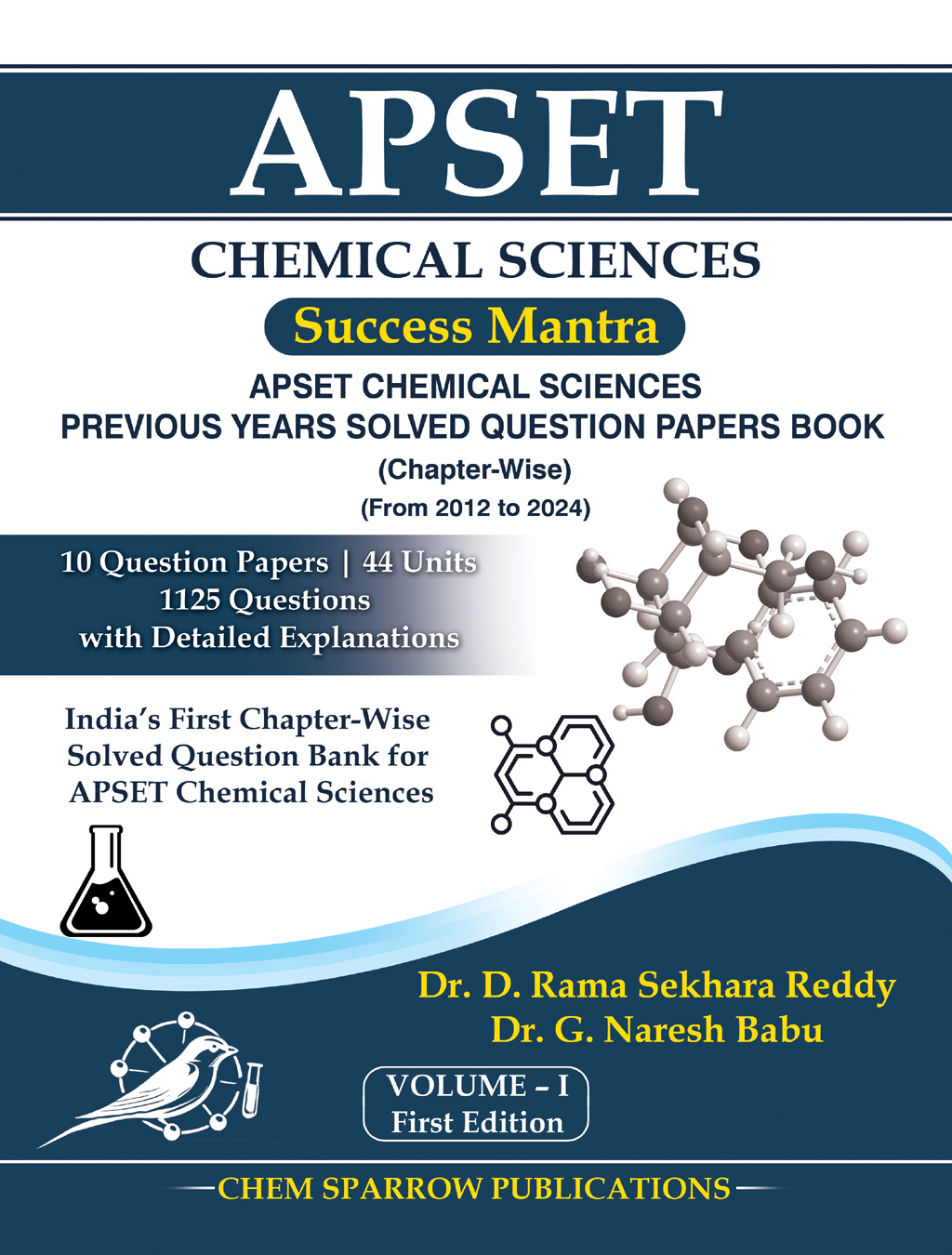
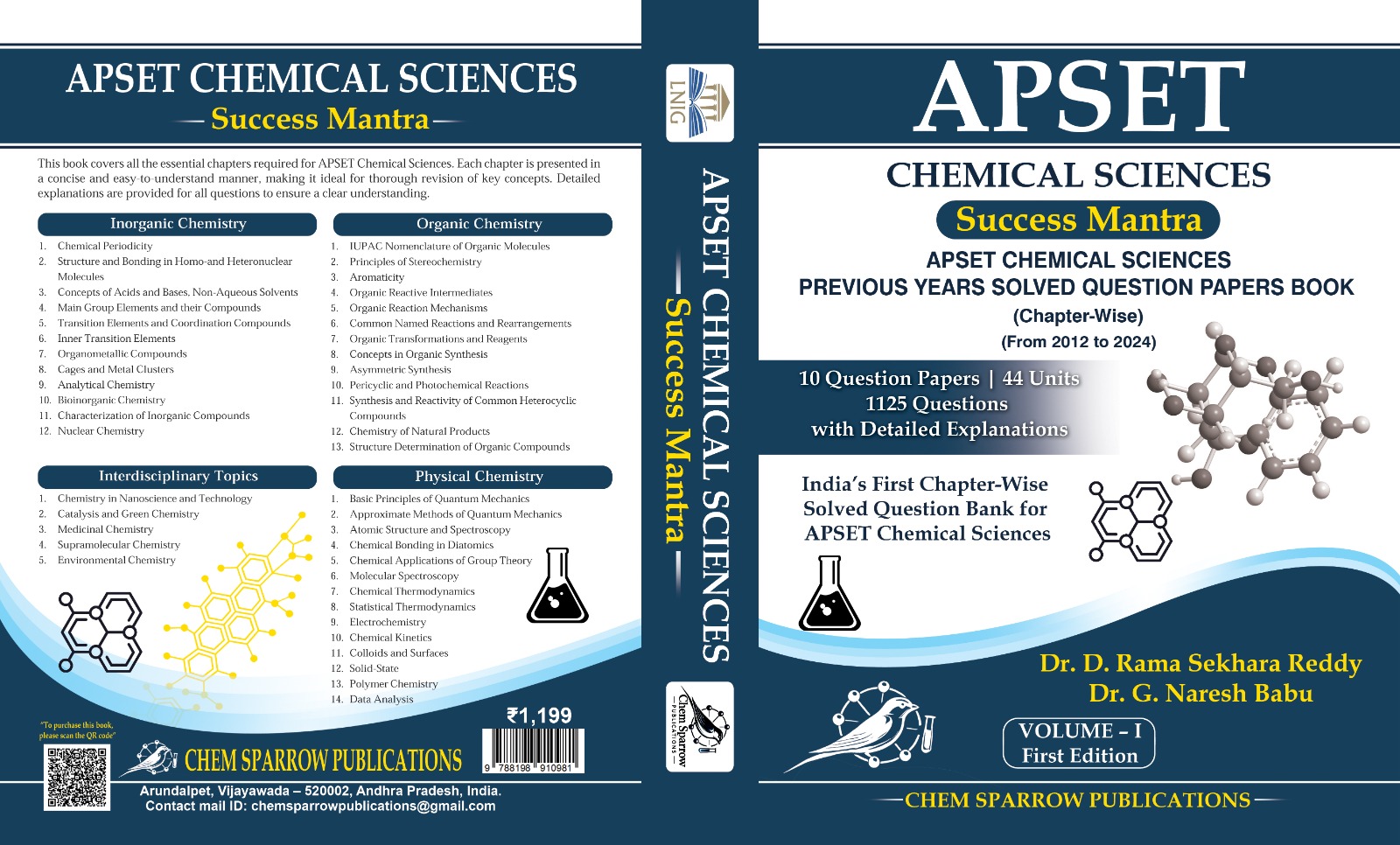
APSET Chemical Sciences Previous Years Solved Question Papers Book (Chapter-Wise)
₹899.00
Title of the Book: APSET Chemical Sciences Previous Years Solved Question Papers Book (Chapter-Wise) From 2012 to 2024.
Author(s): Dr. D. Rama Sekhara Reddy & Dr. G. Naresh Babu
Book Edition: First
Year of Publication: February, 2026
Publications: Chem Sparrow Publications
No. of Pages: 814
ISBN Number: 978-81-989109-8-1
Book Language: English
Book Weight: 1700 grams
Price: ₹899/-
Description
APSET Chemical Sciences Previous Years Solved Question Papers Book (Chapter-Wise) From 2012 to 2024
(India’s First and Exclusive Chapter-Wise Solved Question Bank for APSET Chemical Sciences)
(10 Question Papers| 4 Units | 44 Chapters | 1125 Questions with Detailes Explanations)
About the Book:
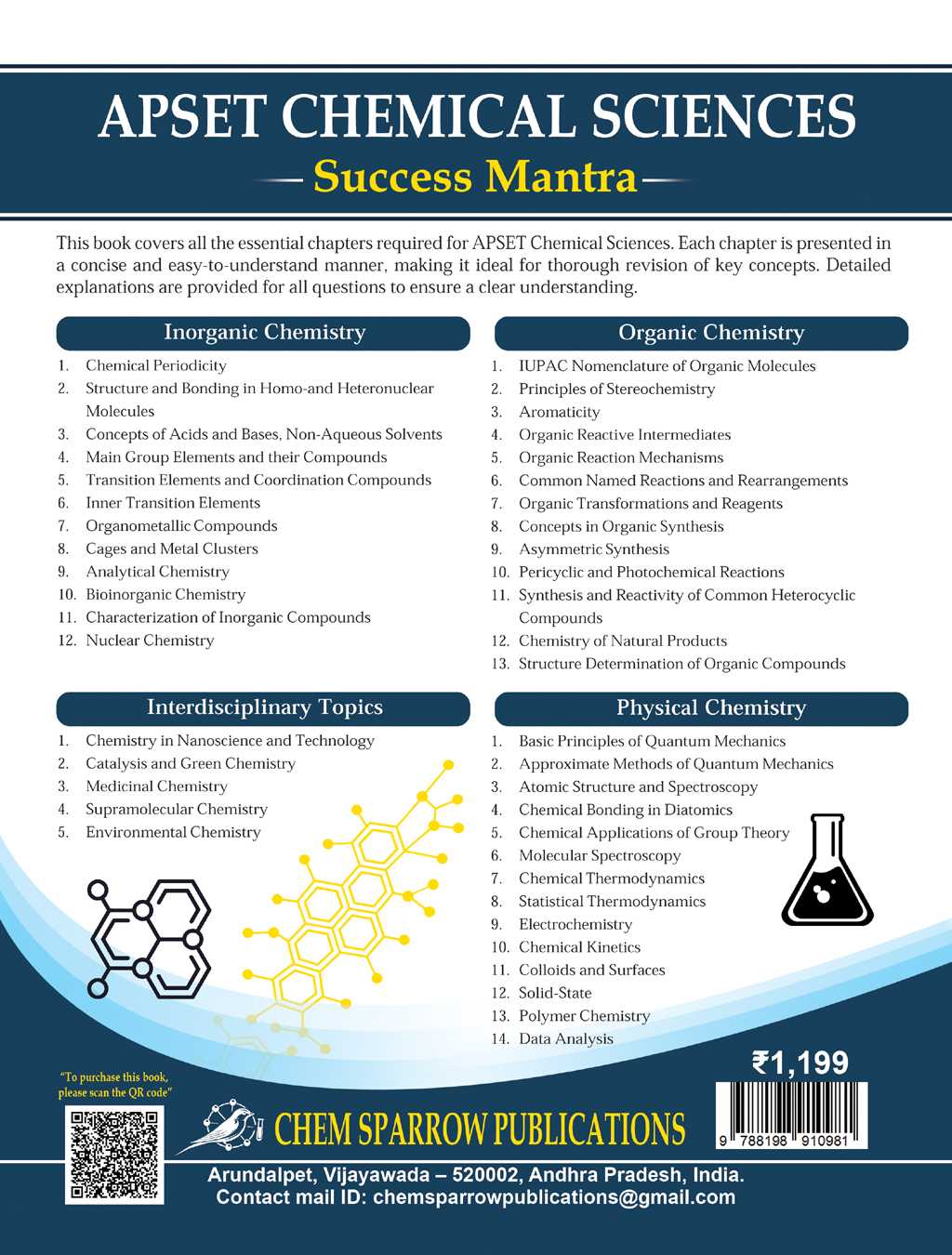
The APSET Chemical Sciences Previous Years Solved Questions (Chapter-Wise) from 2012 to 2024 has been meticulously designed to serve as a comprehensive, reliable, and exam-focused resource for aspirants preparing for the Andhra Pradesh State Eligibility Test (APSET) in Chemical Sciences. Over the years, APSET has evolved into a highly competitive examination that demands not only conceptual clarity but also sustained practice with authentic, trend-based questions. This book aims to bridge that critical gap between syllabus coverage and effective examination readiness. The hallmark of this book lies in its chapter-wise organization strictly aligned with the official APSET syllabus, enabling students to study systematically and revise efficiently. All previous years’ questions from 2012 to 2024 have been carefully compiled, analyzed, and solved with clear, concise, and concept-oriented explanations. Each solution is framed to strengthen fundamental understanding rather than encourage rote memorization, thereby equipping learners to tackle both direct and conceptually twisted questions with confidence.
The book comprehensively covers Inorganic Chemistry, Physical Chemistry, Organic Chemistry, and Interdisciplinary Topics, ensuring holistic preparation. Inorganic Chemistry units emphasize chemical periodicity, structure and bonding, coordination chemistry, organometallics, bioinorganic chemistry, analytical techniques, and nuclear chemistry. Physical Chemistry sections systematically address quantum mechanics, spectroscopy, thermodynamics, electrochemistry, kinetics, solid-state chemistry, polymers, and data analysis with exam-relevant clarity. Organic Chemistry units are presented with strong emphasis on reaction mechanisms, stereochemistry, named reactions, pericyclic reactions, heterocycles, natural products, and spectroscopic structure determination, all of which are high-scoring yet conceptually demanding areas in APSET. The inclusion of interdisciplinary topics such as nanoscience, green chemistry, medicinal chemistry, supramolecular chemistry, and environmental chemistry further strengthens the book’s relevance to the modern APSET syllabus.
Each chapter is curated to help readers identify recurring patterns, frequently tested concepts, and evolving question trends, making this book not just a compilation of solved questions but a strategic learning tool. The step-by-step explanations encourage logical thinking, analytical reasoning, and application of principles—skills that are indispensable for qualifying eligibility examinations. This book will be immensely useful not only for APSET aspirants, but also for candidates preparing for CSIR-UGC-NET, SET examinations of other states, GATE, APPSC, and various postgraduate entrance and eligibility tests. It will equally benefit postgraduate students, research scholars, and teaching faculty seeking a dependable reference for objective-type questions and concept reinforcement. Prepared with academic rigor and examination insight, this book reflects a sincere effort to support students at every stage of their preparation—from foundational learning to final revision. We hope that this volume serves as a trusted companion, instilling confidence, sharpening problem-solving skills, and ultimately contributing to the academic and professional success of its readers.
Contents of the Book:
Unit-I: INORGANIC CHEMISTRY
Chapter-1: Chemical periodicity.
Chapter-2: Structure and bonding in homo- and heteronuclear molecules, including shapes of molecules (VSEPR Theory).
Chapter-3: Concepts of acids and bases, Hard-Soft acid-base concept, and non-aqueous solvents.
Chapter-4: Main group elements and their compounds: Allotropy, synthesis, structure and bonding, industrial importance of the compounds.
Chapter-5: Transition elements and coordination compounds: structure, bonding theories, spectral and magnetic properties, reaction mechanisms.
Chapter-6: Inner transition elements: spectral and magnetic properties, redox chemistry, analytical applications.
Chapter-7: Organometallic compounds: synthesis, bonding and structure, and reactivity. Organometallics in homogeneous catalysis.
Chapter-8: Cages and metal clusters.
Chapter-9: Analytical chemistry- separation, spectroscopic, electro- and thermoanalytical methods.
Chapter-10: Bioinorganic chemistry: photosystems, porphyrins, metalloenzymes, oxygen transport, electron-transfer reactions; nitrogen fixation, metal complexes in medicine.
Chapter-11: Characterization of inorganic compounds by IR, Raman, NMR, EPR, Mössbauer, UV-vis, NQR, MS, electron spectroscopy and microscopic techniques.
Chapter-12: Nuclear chemistry: nuclear reactions, fission and fusion, radio-analytical techniques and activation analysis.
Unit-II: PHYSICAL CHEMISTRY
Chapter-1: Basic principles of quantum mechanics: Postulates; operator algebra; exactly- solvable systems: particle-in-a-box, harmonic oscillator and the hydrogen atom, including shapes of atomic orbitals; orbital and spin angular momenta; tunnelling.
Chapter-2: Approximate methods of quantum mechanics: Variational principle; perturbation theory up to second order in energy; applications.
Chapter-3: Atomic structure and spectroscopy; term symbols; many-electron systems and antisymmetry principle.
Chapter-4: Chemical bonding in diatomics; elementary concepts of MO and VB theories; Huckel theory for conjugated π-electron systems.
Chapter-5: Chemical applications of group theory; symmetry elements; point groups; character tables; selection rules.
Chapter-6: Molecular spectroscopy: Rotational and vibrational spectra of diatomic molecules; electronic spectra; IR and Raman activities – selection rules; basic principles of magnetic resonance.
Chapter-7: Chemical thermodynamics: Laws, state and path functions and their applications; thermodynamic description of various types of processes; Maxwell’s relations; spontaneity and equilibria; temperature and pressure dependence of thermodynamic quantities; Le Chatelier principle; elementary description of phase transitions; phase equilibria and phase rule; thermodynamics of ideal and non-ideal gases, and solutions.
Chapter-8: Statistical thermodynamics: Boltzmann distribution; kinetic theory of gases; partition functions and their relation to thermodynamic quantities – calculations for model systems.
Chapter-9: Electrochemistry: Nernst equation, redox systems, electrochemical cells; Debye- Huckel theory; electrolytic conductance – Kohlrausch’s law and its applications; ionic equilibria; conductometric and potentiometric titrations.
Chapter-10: Chemical kinetics: Empirical rate laws and temperature dependence; complex reactions; steady-state approximation; determination of reaction mechanisms; collision and transition state theories of rate constants; unimolecular reactions; enzyme kinetics; salt effects; homogeneous catalysis; photochemical reactions.
Chapter-11: Colloids and surfaces: Stability and properties of colloids; isotherms and surface area; heterogeneous catalysis.
Chapter-12: Solid-state: Crystal structures; Bragg’s law and applications; band structure of solids.
Chapter-13: Polymer chemistry: Molar masses; kinetics of polymerization.
Chapter-14: Data analysis: Mean and standard deviation; absolute and relative errors; linear regression; covariance and correlation coefficient.
Unit-III: ORGANIC CHEMISTRY
Chapter-1: IUPAC nomenclature of organic molecules including regio- and stereoisomers.
Chapter-2: Principles of stereochemistry: Configurational and conformational isomerism in acyclic and cyclic compounds; stereogenicity, stereoselectivity, enantioselectivity, diastereoselectivity and asymmetric induction.
Chapter-3: Aromaticity: Benzenoid and non-benzenoid compounds – generation and reactions.
Chapter-4: Organic reactive intermediates: Generation, stability and reactivity of carbocations, carbanions, free radicals, carbenes, benzynes and nitrenes.
Chapter-5: Organic reaction mechanisms involving addition, elimination and substitution reactions with electrophilic, nucleophilic or radical species. Determination of reaction pathways.
Chapter-6: Common named reactions and rearrangements – applications in organic synthesis.
Chapter-7: Organic transformations and reagents: Functional group interconversion including oxidations and reductions; common catalysts and reagents (organic, inorganic, organometallic and enzymatic). Chemo, regio and stereoselective transformations.
Chapter-8: Concepts in organic synthesis: Retrosynthesis, disconnection, synthons, linear and convergent synthesis, umpolung of reactivity and protecting groups.
Chapter-9: Asymmetric synthesis: Chiral auxiliaries, methods of asymmetric induction – substrate, reagent and catalyst-controlled reactions; determination of enantiomeric and diastereomeric excess; enantio-discrimination. Resolution – optical and kinetic.
Chapter-10: Pericyclic reactions – electrocyclization, cycloaddition, sigmatropic rearrangements and other related concerted reactions. Principles and applications of photochemical reactions in organic chemistry.
Chapter-11: Synthesis and reactivity of common heterocyclic compounds containing one or two heteroatoms (O, N, S).
Chapter-12: Chemistry of natural products: Carbohydrates, proteins and peptides, fatty acids, nucleic acids, terpenes, steroids and alkaloids. Biogenesis of terpenoids and alkaloids.
Chapter-13: Structure determination of organic compounds by IR, UV-Vis, 1H & 13C NMR and Mass spectroscopic techniques.
Unit-IV: INTERDISCIPLINARY TOPICS
Chapter-1: Chemistry in nanoscience and technology.
Chapter-2: Catalysis and green chemistry.
Chapter-3: Medicinal chemistry.
Chapter-4: Supramolecular chemistry.
Chapter-5: Environmental chemistry.
About the Author(s):
Lt. Dr. D. Rama Sekhara Reddy has been serving as a Head-Department of Chemistry, at Krishna University, Machilipatnam-521004, Andhra Pradesh, India. After taking over as Head of the Department, He has initiated several academic reforms such as Training programs, Guest lectures, Seminars, Workshops, and Conferences to enrich the culture of research and teaching. He believes that a classroom should be a base for the complete personality development of a student. With this in mind, he strived to promote sports and cultural activities in the Department.
Dr.D. Rama Sekhara Reddy received graduation (B.Sc.) from V.R. College, Nellore in the year 1998. He obtained a post-graduation (M. Sc) from Acharya Nagarjuna University, Guntur in the year 2001 and he obtained his Ph.D. from the Department of Organic Chemistry, Andhra University, Visakhapatnam, in the year 2009. During his Doctoral Program, he worked as JRF in a DST-sponsored project under the guidance of Prof. R. Venkateswarlu. After completing his doctoral degree in the area of Natural products Chemistry in 2009 from India, he worked as a Post-Doctoral Fellow at the Institute of Biological Chemistry, Washington State University, WA, USA from 2009-2011and continued as a Post-Doctoral Research Associate at the Centre for Pharmacology, Pharmaceuticals, and Pharmacology, The University of Trans-Disciplinary Health Sciences & Technology (Formerly named I-AIM), Bangalore, K.A, India from 2011-2012. Later in the year 2012, he joined as an Assistant Professor in the Department of Chemistry, at GITAM University, Visakhapatnam, A.P, India. Further in the year 2013, he joined as an Assistant Professor in the Department of Chemistry, at Krishna University, Machilipatnam, A.P, India. Currently, he is acting as Head of the Chemistry Department.
Dr. Naresh Babu Gatchakayala has been serving as a Senior Assistant Professor in the Department of Chemistry at Aditya University, Surampalem-533437, Andhra Pradesh, India. Dr. Naresh Babu Gatchakayala completed his graduation (B.Sc.) from Acharya Nagarjuna University, Guntur, in 2008. He obtained a post-graduation (M.Sc.) from Andhra University, Visakhapatnam, in 2011. He cleared the CSIR-UGC-NET under the Lectureship (LS) category with an All India 33rd rank in the December 2012 session. In the same year, he also qualified in the Andhra Pradesh State Eligibility Test (APSET-2012). In 2011, he joined as the CSIR-UGC-NET Chemical Sciences Subject Coordinator in the Department of Chemistry at JMJ College for Women, Tenali, A.P., India. In 2018, he took up the same role at K.V.R., K.V.R., and M.K.R. College, Khajipalem, A.P., India. He was awarded his Ph.D. under the supervision of Dr. D. Rama Sekhara Reddy from the Department of Chemistry, Krishna University, Machilipatnam, in 2023. He also worked with the “Dr. Chepuri Venkata Ramana Research Group” at CSIR-National Chemical Laboratory, Pune, India, as part of his research. Currently, he is a Senior Assistant Professor in the Department of Chemistry at Aditya University, Surampalem, India.
Dr. Naresh Babu Gatchakayala is recognized as one of the leading resource persons in the fields of teaching, research, and consultancy. He has more than 10 years of teaching experience. His primary teaching interests include Inorganic, Organic, and Physical Chemistry, while his main research areas focus on Nanochemistry and Synthetic Organic Chemistry. He has published 11 research papers in various national and international journals with significant scientific recognition.
BOOK PUBLISHED & MARKETED BY:
Chem Sparrow Publications
D.No. 28-3-58, Arundalpet,
Vijayawada – 520002,
Andhra Pradesh, India.
Contact Number: 91+ 9666236159.
Contact mail ID: [email protected]

Shilpa (Tenali) –
Convenient to practice from. Very student friendly.
Bharath (Bhimavaram) –
A helpful reference book. Useful for Chemical Sciences topics.
Rajeswari (Nandyal) –
Good for exam practice. Concepts became clearer.
Chu –
It’s fantastic that you are getting thoughts from this piece of writing as well as from your argument made here.
Pooja (Kakinada) –
Confidence increased after practice. Questions are well framed.
Gopal (Rajahmundry) –
Helpful for tricky problems. Good preparation aid.
Madhavi (Eluru) –
Neat presentation style. Easy to study from.
Naveen (Anantapur) –
I practiced every day. It improved my results.
SYMALA GOWRI DEVI –
tremendous issues here. I’m very happy to look at your book. Thank you very much, and I look forward to contacting you. Will you please send me your contact details?
MEGHANA SWETHA –
Thank you for providing me with Dr. D. Rama Sekhara Reddy and Mr. Naresh Babu Gatchakayala’s APSET Chemical Sciences Previous Years Solved Questions (Chapter-Wise). I enjoyed reading it. And I also learned so many shortcuts. I appreciate that you thought of me.
SEETA LAKSHMI –
Thank you for giving me APSET Chemical Sciences Previous Years Solved Questions (Chapter-Wise) By Dr. D. Rama Sekhara Reddy & Mr. Naresh Babu Gachakayala. I learned so many shortcuts.
LAKSHMI KAVYA –
I thoroughly enjoyed the book APSET Chemical Sciences Previous Years’ Solved Questions. The subject matter will help me to solve various APSET Chemical Sciences Previous Year’s Questions, and I learned more shortcuts.
GANESH –
Thank you for the book you gave me last week! You chose a great book for me to prepare for APSET Chemical Sciences. I have already read it and loved the subject matter in it. I enjoyed it so much that I plan to read the entire series.
INDIRA –
I want to thank you for the book you gave me about APSET Chemical Sciences Previous Years’ Solved Questions (Chapter-Wise). I was able to relate to the ways Dr. D. Rama Sekhara Reddy & Mr. Naresh Babu Gatchakayala talk about their subject matter. I am confident that the recommendations for dealing with the topic will be implemented. You were right when you told me that I needed to read APSET Chemical Sciences Previous Years’ Solved Questions (chapter-wise). Getting help from a book is easier for me than discussing problems with my friends.
MADHU SUDANA RAO –
Hey there! I could have sworn I’d been to this book before, but after studying through some of the books, I realized it was new to me. Anyways, I’m definitely delighted I found it, and I’ll be ordering it.
MANIKANTESWARA RAO –
It is currently the sole book available for the APSET Chemical Sciences Entrance Exam. We appreciate the authors.
Pragna –
I read this book fully on the topic APSET Chemical Sciences Previous Years Solved Questions (Chapter-Wise), it’s an awesome book.
Vinod –
This book is worth everyone’s attention. How can I contact you?
LAKSHMI –
I’ve been browsing online for more than 3 hours lately, but I by no means discovered any fascinating books like this. It is a lovely price for me. In my opinion, if all writers produced high-quality content, as you most likely did, the preparation would be far more useful than ever before.
SRAVYANKA –
Good book, thank you so much. This book has been very helpful in my APSET preparation.
RAMANA –
It’s very interesting, I want to purchase this book. Can you tell us more about this? I’d like to find out more details.
BALA RAMESWARI –
I like the valuable information you supply in your books. I’ll order your book and check back here frequently for future editions. I am moderately sure you are going to give us more information in your upcoming editions.
RUSHI KESAVA RAO –
hello!, I like your writing very much! I admired your book on the chemistry of organolithium. I need an expert to solve chemistry problems. Maybe that’s you! I am waiting to contact you.
CHANDRA KALA –
I appreciate your dedication to writing this book and the detailed information you offer. It’s nice to come across a book every once in a while that isn’t the same old rehashed material. Wonderful read! I’ve ordered this book, and I’m promoting it in my circle.
SARMA –
Oh, what a wonderful book this was. The writers of this book made the time and real effort to write this fantastic book.
DAKSHAYANI –
Good Book, I seriously believe this amazing book is very helpful to me. I’ll probably be back again to purchase more books, thanks to my friend for the advice!
Sujatha (Gudur) –
Concepts became clear quickly. Very helpful guide.
Dheeraj (Proddatur) –
Nicely compiled questions. Useful for preparation.
Ramesh (Adilabad) –
Good material for aspirants. Helpful for practice.
Indu (Amalapuram) –
Revision became smoother. It saved my time.
Chandu (Kadapa) –
Helped me stay consistent. Good practice source.
Arvind (Tirupati) –
Supportive guide for study. Preparation became easier.
Kalyani (Nellore) –
Practice became effective. Concept clarity improved.
Venkata Rao (Guntur) –
Good collection of questions. Useful for serious aspirants.
Hema (Rajahmundry) –
Strengthened my readiness. Very helpful book.
Sai Teja (Bhimavaram) –
I practiced with confidence. It really helped my preparation.
Bhavana (Amalapuram) –
Easy to use and well structured.
Karthikeya (Proddatur) –
Helpful for improving accuracy.
Ravindra (Gajuwaka) –
I liked the neat arrangement of chapters.
Snehalatha (Gudivada): –
This book made my revision systematic.
Prakash (Adoni) –
The question selection is impressive.
K. LAKSHMI KAVYA –
The APSET Chemical Sciences Previous Years Solved Questions book is an invaluable tool for anyone preparing for the APSET exam. It provides a comprehensive collection of past questions, along with detailed, easy-to-understand solutions that aid in mastering the subject matter. This book is a confidence booster, helping candidates become well-acquainted with the exam pattern and enhancing their problem-solving skills. The quality of the content is outstanding, making it an essential resource for those aiming to excel in the APSET Chemical Sciences examination. It’s a must-have for anyone serious about their APSET preparation.
D. GANESH –
The APSET Chemical Sciences Previous Years Solved Questions book is a game-changer for aspirants. Its well-structured content and detailed solutions make it an indispensable tool for acing the exam. This book not only offers a comprehensive review of the subject but also serves as a confidence booster, helping candidates understand the exam pattern. The abundance of solved questions gives a clear insight into the type and difficulty level of questions one can expect in the APSET Chemical Sciences exam. It’s a must-have for anyone serious about excelling in this field.
D. INDIRA –
The APSET Chemical Sciences Previous Years Solved Questions book is an invaluable tool for anyone preparing for the APSET exam. It provides a comprehensive and structured approach to studying, offering detailed solutions to past year’s questions that help build a strong foundation in the subject. The book’s clear explanations and well-organized content make it easy to understand complex concepts, and its extensive question bank ensures thorough practice. As a dedicated student, I found this book to be an indispensable resource in my journey to success, and I highly recommend it to all APSET aspirants.
U. MADHU SUDANA RAO –
This book greatly enhanced my exam preparation and confidence by offering comprehensive solutions.
P. MANIKANTESWARA RAO –
This book is an invaluable resource, offering comprehensive and well-explained solutions that have greatly enhanced my preparation for the exam.”
D. SANTOSH –
“APSET Chemical Sciences Previous Years Solved Questions book is an invaluable resource, providing comprehensive preparation with clear explanations and accurate solutions, making it a must-have for success in the APSET exam.”
Sushma (Khammam) –
Very convenient for daily practice.
Divakar (Karimnagar) –
The book guided me toward important topics.
Harsha (Warangal) –
I felt more prepared after using this book.
Tejaswini (Hyderabad) –
Clear format made solving comfortable.
Rakesh (Nandyal) –
A well-organized question bank.
Nandini (Tadepalligudem) –
Very helpful for understanding repeated question types.
Rajesh (Bhimavaram) –
It strengthened my fundamentals through practice.
Lalitha (Tenali) –
This book helped me plan my study schedule.
Mahendra (Chittoor): –
A dependable practice book for Chemical Sciences.
Swaroopa (Vizianagaram) –
I found it helpful for quick concept recall.
Raghu (Srikakulam) –
The book clearly reflects the APSET pattern.
Anusha (Machilipatnam) –
A useful addition to my exam preparation books.
Chaitanya (Tirupati) –
Questions are well arranged and easy to practice.
Deepthi (Anantapur) –
Helped me revise faster before mock tests.
Vamsi Krishna (Ongole) –
Good compilation of important previous questions.
Pavithra (Eluru) –
I liked the simple explanation style.
Ganesh (Kadapa) –
This book improved my question-solving confidence.
Keerthi (Rajahmundry) –
Useful resource for self-study students like me.
Srinath (Nellore) –
The solutions are reliable and easy to follow.
Harini (Vijayawada) –
It helped me recognize which chapters carry more weightage.
Madhusudhan (Kurnool) –
A very practical guide for APSET preparation.
Sailaja –
I understood important concepts better after solving these previous papers.
Rohit Kumar –
This book made my preparation structured because I could practice questions topic by topic.
Anitha Chowdary –
“Language is simple and easy to understand even for self-study students.”
Suresh Babu –
“This book helped me understand frequently asked topics in Chemical Sciences.”
Bhavani P. –
“I liked the clear explanation for numerical problems. It improved my solving speed.”
Prasad K. (Kakinada) –
“Solutions are accurate and match APSET exam pattern. Highly recommended for serious aspirants.”
Divya Lakshmi (Vijayawada) –
“Very useful for quick revision. I completed entire syllabus revision in less time.”
Naresh Reddy (Tirupati) –
“Chapter-wise arrangement is the biggest advantage. It saved my preparation time.”
Sravani M. (Guntur) –
“The solved answers are very clear and simple. I felt confident after practicing from this book.”
Ravi Kumar (Visakhapatnam) –
“This book helped me a lot in understanding chapter-wise questions. I could easily focus on weak topics before the exam.”
Venkat –
Nice book…I am referring this book
Bhavya (Eluru) –
I used this book regularly during preparation. It helped me understand important concepts better. A very useful study companion.
Krishna Murthy (Srikakulam) –
A solid question collection.
Great for practice.
Praneeth Kumar (Kurnool) –
This book helped me practice consistently. The questions reflect actual exam standards. It gave me more confidence.
Anjali (Rajahmundry) –
The format is simple and easy to follow. I could revise concepts quickly before tests. It supported my preparation well.
Meghana (Vizianagaram) –
I found this book very easy to use. The arrangement made practice smooth. It saved me a lot of time.
Vinay Kumar (Srikakulam) –
A well compiled set of questions. It improved my understanding of topics. I found it very effective.
Sowmya (Vijayawada) –
This is a very useful resource for APSET aspirants. The questions are relevant and exam oriented. It made my revision much easier.
Rohith Reddy (Kadapa): –
The book is very practical for daily practice. I could clearly understand my weak areas. It helped me improve step by step.
Kavitha (Nandyal) –
This book helped me stay consistent in study. The structure is very convenient. It made preparation easier.
Naresh (Bhimavaram) –
Questions are very useful for exam practice. I felt more prepared after solving them. It is a dependable resource.
Divya Sri (Machilipatnam) –
The book is simple and student friendly. I could understand concepts quickly. It made revision stress-free.
Suresh (Anantapur) –
I practiced daily from this book. It improved my problem-solving ability. A very helpful guide overall.
K Sravani (verified owner) –
Excellent book sir….it’s very biggest advantage to cover all the topics easily…we can easily cover all the chapters in short time..very good explanation to each and every question… really it is a India’s first book which has all year questions chapterwise.thank u sir
Prathyusha (Vizianagaram) –
Good support material. Helpful for revision.
Raghuveer (Warangal) –
A very good practice source for competitive exams. It helped me analyze important topics. Preparation became more focused.
Esther –
Questions are well chosen. They improve problem solving.
Tejal (Hyderabad) –
The questions are well chosen and relevant. I could prepare without confusion. It really helped in final revision.
Harsha Vardhan (Tirupati) –
This book strengthened my basics. Regular practice improved my performance. It is a good support material.
Lakshmi (Tenali): –
I liked the clarity in presentation. Studying became easier and more systematic. It is helpful for revision.
Charan (Ongole) –
The question collection is very good. It improved my solving speed gradually. I found it very reliable.
Niharika (Guntur) –
I liked how neatly the questions are arranged. It was easy to revise important topics quickly. A very helpful guide for exam preparation.
Padmaja (Kakinada) –
I liked practicing from this book every day. It strengthened my concepts gradually. A very useful preparation tool.
Vemuri Lakshmi Ganesh (verified owner) –
This book is having all the pyqs questions arranged in a chapter wise and proper explanation..I would say with this book, itself u can get whole idea on most of the topics . Really appreciated the way the gave the solutions to each question.
Lavanya (Karimnagar) –
Helpful before exams. Quick revision became possible.
Aditya (Vizag) –
This book made my preparation more organized and focused. I practiced questions topic-wise without confusion. It really helped me stay confident throughout my preparation.