

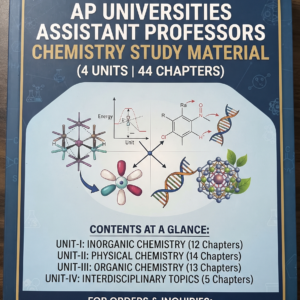
AP Universities Assistant Professors Chemistry
₹3,000.00
Courses Included
Description
AP Universities Assistant Professors Chemistry
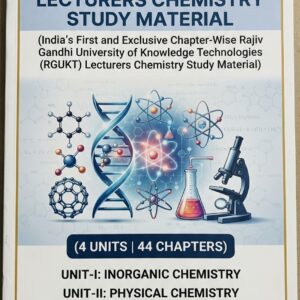
(India’s First and Exclusive Chapter-Wise AP Universities Assistant Professors Chemistry)
(10 Question Papers| 4 Units | 44 Chapters)
Contents:
Unit-I: INORGANIC CHEMISTRY
Chapter-1: Chemical periodicity.
Chapter-2: Structure and bonding in homo- and heteronuclear molecules, including shapes of molecules (VSEPR Theory).
Chapter-3: Concepts of acids and bases, Hard-Soft acid-base concept, and non-aqueous solvents.
Chapter-4: Main group elements and their compounds: Allotropy, synthesis, structure and bonding, industrial importance of the compounds.
Chapter-5: Transition elements and coordination compounds: structure, bonding theories, spectral and magnetic properties, reaction mechanisms.
Chapter-6: Inner transition elements: spectral and magnetic properties, redox chemistry, analytical applications.
Chapter-7: Organometallic compounds: synthesis, bonding and structure, and reactivity. Organometallics in homogeneous catalysis.
Chapter-8: Cages and metal clusters.
Chapter-9: Analytical chemistry- separation, spectroscopic, electro- and thermoanalytical methods.
Chapter-10: Bioinorganic chemistry: photosystems, porphyrins, metalloenzymes, oxygen transport, electron-transfer reactions; nitrogen fixation, metal complexes in medicine.
Chapter-11: Characterization of inorganic compounds by IR, Raman, NMR, EPR, Mössbauer, UV-vis, NQR, MS, electron spectroscopy and microscopic techniques.
Chapter-12: Nuclear chemistry: nuclear reactions, fission and fusion, radio-analytical techniques and activation analysis.
Unit-II: PHYSICAL CHEMISTRY
Chapter-1: Basic principles of quantum mechanics: Postulates; operator algebra; exactly- solvable systems: particle-in-a-box, harmonic oscillator and the hydrogen atom, including shapes of atomic orbitals; orbital and spin angular momenta; tunnelling.
Chapter-2: Approximate methods of quantum mechanics: Variational principle; perturbation theory up to second order in energy; applications.
Chapter-3: Atomic structure and spectroscopy; term symbols; many-electron systems and antisymmetry principle.
Chapter-4: Chemical bonding in diatomics; elementary concepts of MO and VB theories; Huckel theory for conjugated π-electron systems.
Chapter-5: Chemical applications of group theory; symmetry elements; point groups; character tables; selection rules.
Chapter-6: Molecular spectroscopy: Rotational and vibrational spectra of diatomic molecules; electronic spectra; IR and Raman activities – selection rules; basic principles of magnetic resonance.
Chapter-7: Chemical thermodynamics: Laws, state and path functions and their applications; thermodynamic description of various types of processes; Maxwell’s relations; spontaneity and equilibria; temperature and pressure dependence of thermodynamic quantities; Le Chatelier principle; elementary description of phase transitions; phase equilibria and phase rule; thermodynamics of ideal and non-ideal gases, and solutions.
Chapter-8: Statistical thermodynamics: Boltzmann distribution; kinetic theory of gases; partition functions and their relation to thermodynamic quantities – calculations for model systems.
Chapter-9: Electrochemistry: Nernst equation, redox systems, electrochemical cells; Debye- Huckel theory; electrolytic conductance – Kohlrausch’s law and its applications; ionic equilibria; conductometric and potentiometric titrations.
Chapter-10: Chemical kinetics: Empirical rate laws and temperature dependence; complex reactions; steady-state approximation; determination of reaction mechanisms; collision and transition state theories of rate constants; unimolecular reactions; enzyme kinetics; salt effects; homogeneous catalysis; photochemical reactions.
Chapter-11: Colloids and surfaces: Stability and properties of colloids; isotherms and surface area; heterogeneous catalysis.
Chapter-12: Solid-state: Crystal structures; Bragg’s law and applications; band structure of solids.
Chapter-13: Polymer chemistry: Molar masses; kinetics of polymerization.
Chapter-14: Data analysis: Mean and standard deviation; absolute and relative errors; linear regression; covariance and correlation coefficient.
Unit-III: ORGANIC CHEMISTRY
Chapter-1: IUPAC nomenclature of organic molecules including regio- and stereoisomers.
Chapter-2: Principles of stereochemistry: Configurational and conformational isomerism in acyclic and cyclic compounds; stereogenicity, stereoselectivity, enantioselectivity, diastereoselectivity and asymmetric induction.
Chapter-3: Aromaticity: Benzenoid and non-benzenoid compounds – generation and reactions.
Chapter-4: Organic reactive intermediates: Generation, stability and reactivity of carbocations, carbanions, free radicals, carbenes, benzynes and nitrenes.
Chapter-5: Organic reaction mechanisms involving addition, elimination and substitution reactions with electrophilic, nucleophilic or radical species. Determination of reaction pathways.
Chapter-6: Common named reactions and rearrangements – applications in organic synthesis.
Chapter-7: Organic transformations and reagents: Functional group interconversion including oxidations and reductions; common catalysts and reagents (organic, inorganic, organometallic and enzymatic). Chemo, regio and stereoselective transformations.
Chapter-8: Concepts in organic synthesis: Retrosynthesis, disconnection, synthons, linear and convergent synthesis, umpolung of reactivity and protecting groups.
Chapter-9: Asymmetric synthesis: Chiral auxiliaries, methods of asymmetric induction – substrate, reagent and catalyst-controlled reactions; determination of enantiomeric and diastereomeric excess; enantio-discrimination. Resolution – optical and kinetic.
Chapter-10: Pericyclic reactions – electrocyclization, cycloaddition, sigmatropic rearrangements and other related concerted reactions. Principles and applications of photochemical reactions in organic chemistry.
Chapter-11: Synthesis and reactivity of common heterocyclic compounds containing one or two heteroatoms (O, N, S).
Chapter-12: Chemistry of natural products: Carbohydrates, proteins and peptides, fatty acids, nucleic acids, terpenes, steroids and alkaloids. Biogenesis of terpenoids and alkaloids.
Chapter-13: Structure determination of organic compounds by IR, UV-Vis, 1H & 13C NMR and Mass spectroscopic techniques.
Unit-IV: INTERDISCIPLINARY TOPICS
Chapter-1: Chemistry in nanoscience and technology.
Chapter-2: Catalysis and green chemistry.
Chapter-3: Medicinal chemistry.
Chapter-4: Supramolecular chemistry.
Chapter-5: Environmental chemistry.
Contact:
Contact Number: 91+ 9666236159.
Reviews
There are no reviews yet.