
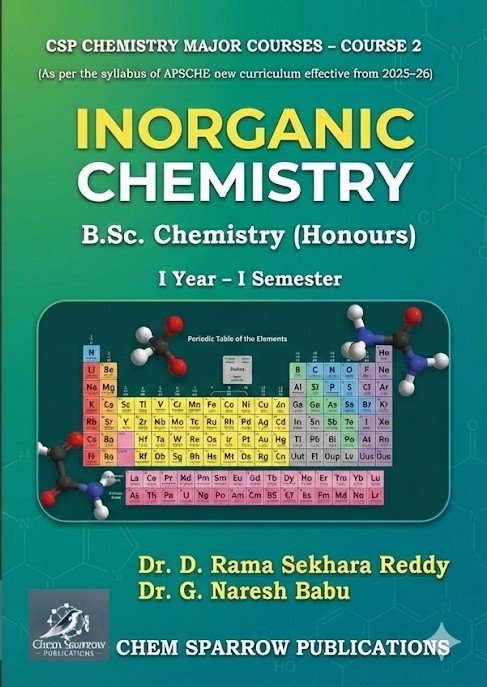
Inorganic Chemistry by Dr. D. Rama Sekhara Reddy & Dr. G. Naresh Babu
₹200.00
Title of the Book: Inorganic Chemistry (Including Practical: Inorganic Preparations)
Author(s): Dr. D. Rama Sekhara Reddy & Dr. G. Naresh Babu
Book Edition: First
Year of Publication: December, 2025
Publications: Chem Sparrow Publications
No. of Pages: 144
ISBN Number: 978-81-989109-2-9
Book Language: English
Book Weight: 200 grams
Book Price: Rs. 200/-
Description
Inorganic Chemistry
(Including Practical: Inorganic Preparations)
About the Book:
This book, “Inorganic Chemistry (Including Practical: Inorganic Preparations),” is the second book in the CSP Chemistry Major Courses – Book Series. It is designed to serve as a comprehensive foundation text for undergraduate students pursuing Chemistry as a major subject. The book follows the revised APSCHE curriculum, providing a clear, concise, and concept-oriented approach that helps students build a strong base in fundamental principles before advancing to higher-level courses in inorganic, organic, and physical chemistry.
The Inorganic Chemistry course is organized into five focused units, along with a Practical component on Inorganic Preparations, providing a clear and structured understanding of essential inorganic principles. The curriculum highlights key areas such as the structures of important p-block compounds including diborane, borazine, silicones, and phosphonitrilic chloride; the classification and behavior of oxides, sulphur oxoacids, interhalogens, and pseudohalogens; and the major characteristic properties of d-block elements, particularly variable oxidation states, colour, magnetism, and catalytic activity. Students further explore the core features of lanthanides and actinides, focusing on their electronic configurations, oxidation states, magnetic properties, and contraction trends. The section on metallurgy emphasizes essential processes such as ore concentration, oxidation–reduction, refining techniques, and corrosion prevention. The Practical Inorganic Preparations component reinforces theoretical knowledge through hands-on synthesis of selected inorganic compounds.
The completion of this book has been made possible through the collective efforts of the editorial and academic teams, whose dedication to quality and accuracy ensured that the content aligns with the APSCHE curriculum framework. We express our sincere gratitude to all faculty members, reviewers, and contributors who provided their valuable feedback and insights.
Through this series, our aim is to strengthen the foundation of chemical education in Andhra Pradesh by offering accessible, well-structured, and exam-oriented resources that foster analytical thinking and scientific curiosity. We hope that this book, Inorganic Chemistry (Course–2), will serve as a reliable guide and an inspiring companion for both students and educators, paving the way for deeper exploration of the fascinating world of chemistry.
Contents of the Book:
UNIT-1: Chemistry of p-Block Elements – I (9 Hours):
Group 13: Preparation and structures of diborane, borazine, and (BN)x.
Group 14: Preparation, classification, and uses of silicones.
Group 15: Preparation and structure of phosphonitrilic chloride, P₃N₃Cl₆.
UNIT-2: Chemistry of p-Block Elements – II (9 Hours):
Group 16: Classification of oxides; structures of oxides and oxoacids of sulphur.
Group 17: Preparation and structures of interhalogen compounds and pseudohalogens.
UNIT-3: Chemistry of d-Block Elements (9 Hours):
Characteristics of d-block elements with special reference to electronic configuration, variable valency, colour, magnetic properties, catalytic properties, and the ability to form complexes. Stability of various oxidation states of the 3d series.
UNIT-4: Chemistry of f-Block Elements(9 Hours):
Chemistry of Lanthanides: Electronic configuration, oxidation states, colour, magnetic properties, lanthanide contraction, and consequences of lanthanide contraction.
Chemistry of Actinides: Electronic configuration, oxidation states, actinide contraction, and comparison of lanthanides and actinides.
UNIT-5: General Principles of Metallurgy (9 Hours): Occurrence of metals, minerals, and ores. Concentration of ores: Levigation, magnetic separation, froth flotation, and leaching. Conversion of concentrated ores to oxides: Calcination and roasting. Reduction of oxides to metals. Refining of crude metals: Distillation, liquation, poling, electrolysis, zone refining, and vapour-phase refining. Corrosion and its prevention; alloys.
About the Author(s):
Lt. Dr. D. Rama Sekhara Reddy has been serving as a Head-Department of Chemistry, at Krishna University, Machilipatnam-521004, Andhra Pradesh, India. After taking over as Head of the Department, He has initiated several academic reforms such as Training programs, Guest lectures, Seminars, Workshops, and Conferences to enrich the culture of research and teaching. He believes that a classroom should be a base for the complete personality development of a student. With this in mind, he strived to promote sports and cultural activities in the Department.
Dr.D. Rama Sekhara Reddy received graduation (B.Sc.) from V.R. College, Nellore in the year 1998. He obtained a post-graduation (M. Sc) from Acharya Nagarjuna University, Guntur in the year 2001 and he obtained his Ph.D. from the Department of Organic Chemistry, Andhra University, Visakhapatnam, in the year 2009. During his Doctoral Program, he worked as JRF in a DST-sponsored project under the guidance of Prof. R. Venkateswarlu. After completing his doctoral degree in the area of Natural products Chemistry in 2009 from India, he worked as a Post-Doctoral Fellow at the Institute of Biological Chemistry, Washington State University, WA, USA from 2009-2011and continued as a Post-Doctoral Research Associate at the Centre for Pharmacology, Pharmaceuticals, and Pharmacology, The University of Trans-Disciplinary Health Sciences & Technology (Formerly named I-AIM), Bangalore, K.A, India from 2011-2012. Later in the year 2012, he joined as an Assistant Professor in the Department of Chemistry, at GITAM University, Visakhapatnam, A.P, India. Further in the year 2013, he joined as an Assistant Professor in the Department of Chemistry, at Krishna University, Machilipatnam, A.P, India. Currently, he is acting as Head of the Chemistry Department.
Dr Reddy’s main research interests include Natural Products Chemistry, Synthetic Organic Chemistry and Nano Chemistry. He is guiding research scholars for M.Phill and Ph.D programmes. Under his guidance, Ten Ph.D’s, one M.Phil degree was awarded and currently four research students were working with his group. He published more than 50 research publications in various national and international journals with a scientific reputation. He is currently serving as a potential reviewer for various Scopus and SCI journals and also authored four text books and five book chapters. Apart from his academics, he also serves various administrative positions at present as Dean for College Development Council (CDC), Associate NCC Officer (ANO) and also a member in the Board of Studies of various reputed varsities and autonomous colleges. Earlier he served in different administrative positions like Director, Directorate of Admissions, Controller of Examinations, Training and Placement officer etc.

Dr. Naresh Babu Gatchakayala has been serving as an Assistant Professor in the Department of Chemistry at Aditya University, Surampalem-533437, Andhra Pradesh, India. Dr. Naresh Babu Gatchakayala completed his graduation (B.Sc.) from Acharya Nagarjuna University, Guntur, in 2008. He obtained a post-graduation (M.Sc.) from Andhra University, Visakhapatnam, in 2011. He cleared the CSIR-UGC-NET under the Lectureship (LS) category with an All India 33rd rank in the December 2012 session. In the same year, he also qualified in the Andhra Pradesh State Eligibility Test (APSET-2012). He was awarded his Ph.D. under the supervision of Dr. D. Rama Sekhara Reddy from the Department of Chemistry, Krishna University, Machilipatnam, in 2023. He also worked with the “Dr. Chepuri Venkata Ramana Research Group” at CSIR-National Chemical Laboratory, Pune, India, as part of his research. In 2011, he joined as the CSIR-UGC-NET Chemical Sciences Subject Coordinator in the Department of Chemistry at JMJ College for Women, Tenali, A.P., India. In 2018, he took up the same role at K.V.R., K.V.R., and M.K.R. College, Khajipalem, A.P., India. Currently, he is a Senior Assistant Professor in the Department of Chemistry at Aditya University, Surampalem, India.
Dr. Naresh Babu Gatchakayala is recognized as one of the leading resource persons in the fields of teaching, research, and consultancy. He has more than 10 years of teaching experience. His primary teaching interests include Inorganic, Organic, and Physical Chemistry, while his main research interests include Nanochemistry, Synthetic Organic Chemistry, and Medicinal Chemistry. He is guiding research scholars for M.Sc. and Ph.D. programmes, and currently, two research scholars are working under his supervision. He has published more than 10 research papers in reputed national and international journals of scientific repute. In addition, he has authored two textbooks and holds two patents for his innovative research contributions.
BOOK PUBLISHED & MARKETED BY:
Chem Sparrow Publications
D.No. 28-3-58, Arundalpet,
Vijayawada – 520002,
Andhra Pradesh, India.
Contact Number: 91+ 9666236159.
Contact mail ID: [email protected]

Reviews
There are no reviews yet.