
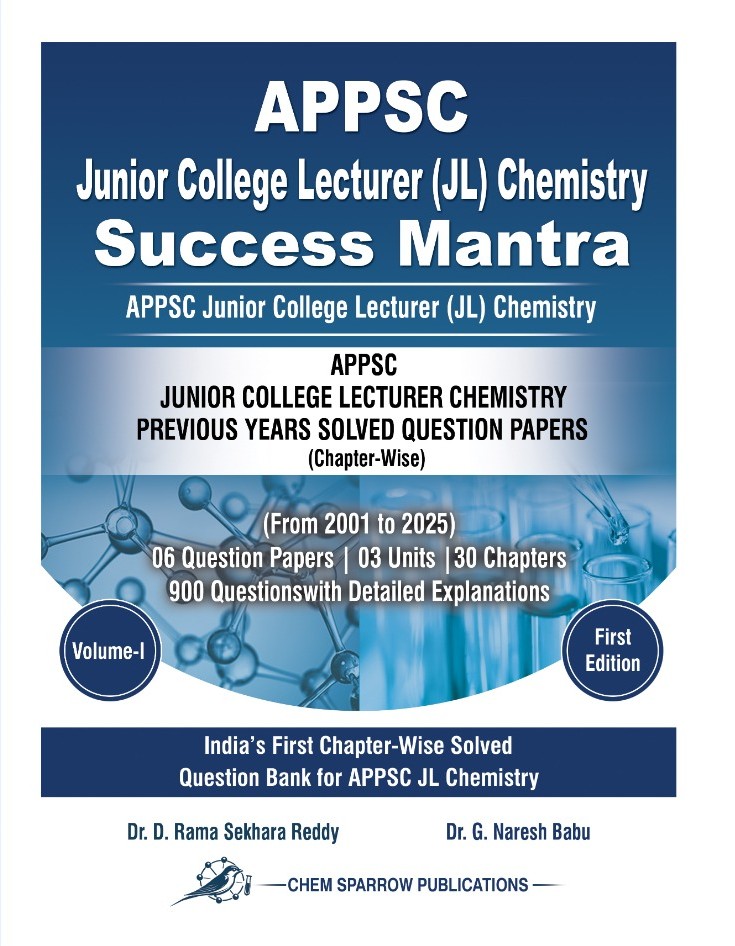
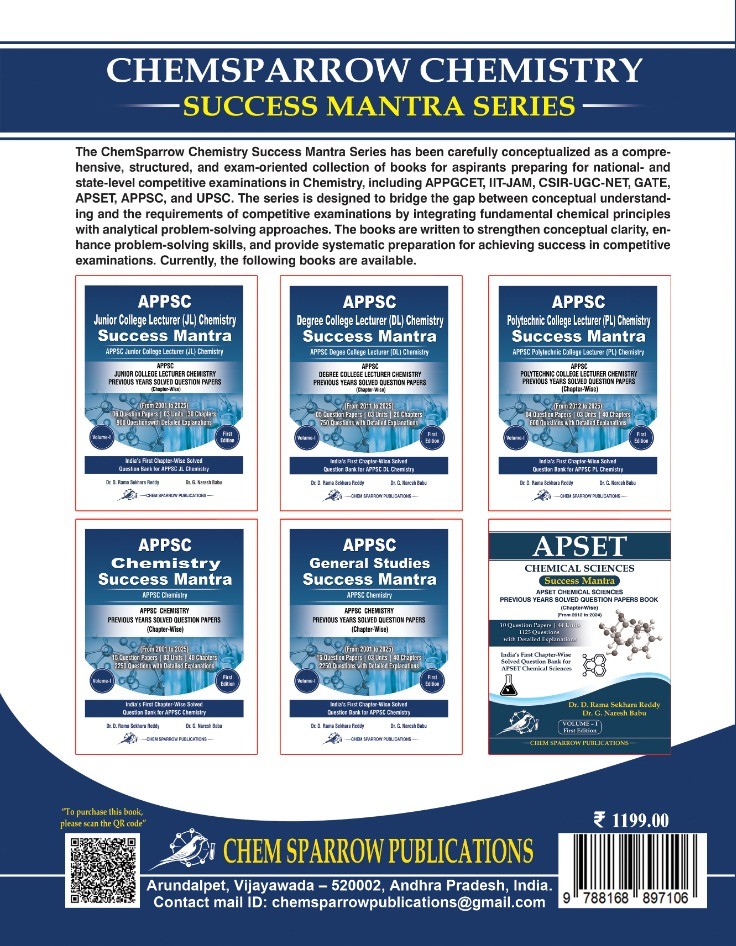
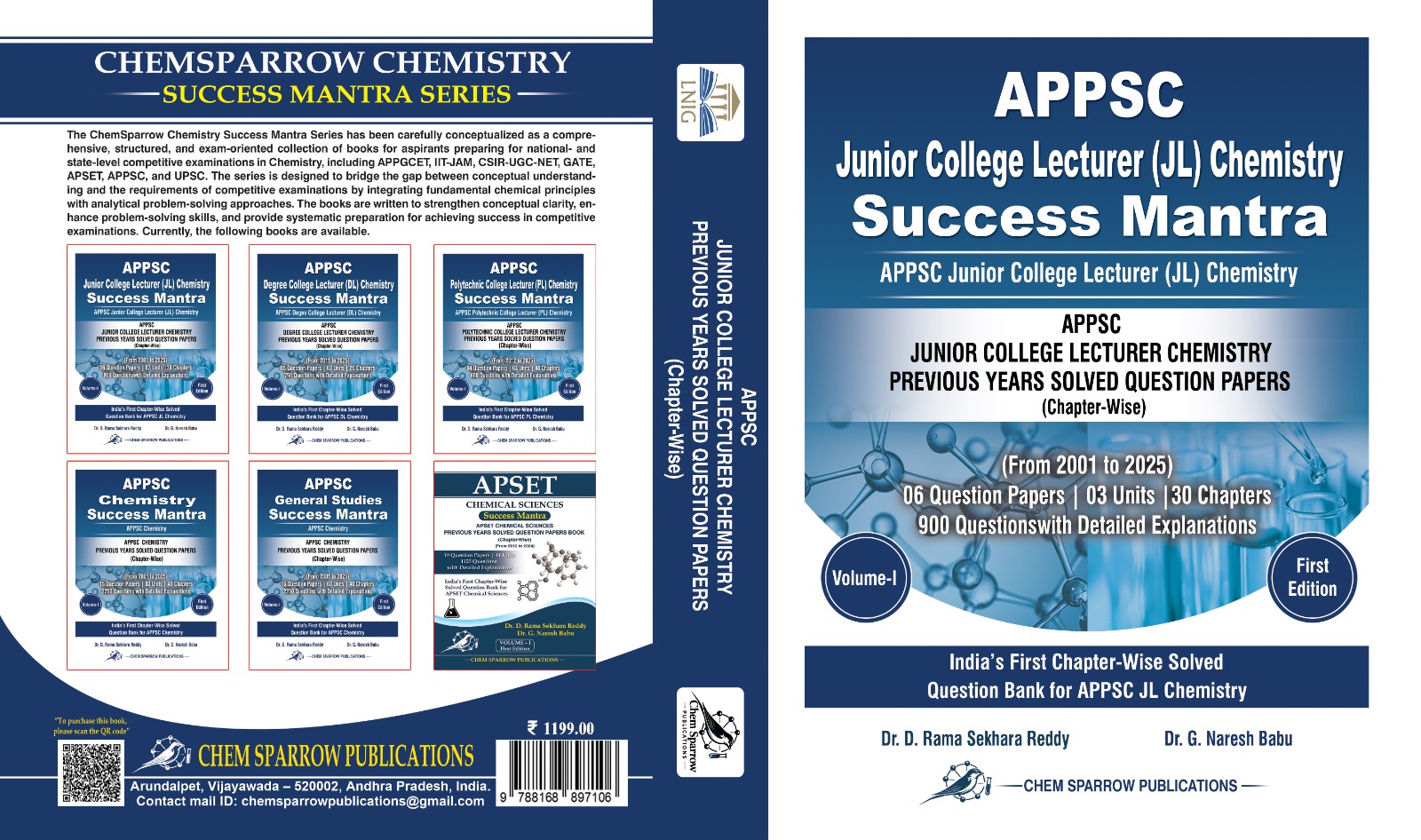
APPSC Junior College Lecturer Chemistry Previous Years Solved Question Papers (Chapter-Wise)
₹1,199.00
Title of the Book: APPSC Junior College Lecturer (JL) Chemistry Previous Years Solved Question Papers (Chapter-Wise).
Author(s): Dr. D. Rama Sekhara Reddy & Dr. G. Naresh Babu
Book Edition: First
Year of Publication: July, 2026
Publications: Chem Sparrow Publications
No. of Pages: 744
ISBN Number: 978-81-688971-0-6
Book Language: English
Book Weight: 1550 grams
Price: ₹1199/-
Description
APPSC Junior College Lecturer (JL) Chemistry Previous Years Solved Question Papers (Chapter-Wise)
(2001, 2004, 2008, 2011, 2020 and 2025)
(India’s First and Exclusive Chapter-Wise Solved Question Bank for APPSC Junior College Lecturer Chemistry)
(6 Question Papers| 3 Units | 30 Chapters | 900 Questions with Detailes Explanations)
About the Book:
APPSC Junior College Lecturer (JL) Chemistry Previous Years Solved Question Papers (Chapter-Wise) (2001, 2004, 2008, 2011, 2020 & 2025) has been meticulously developed as a comprehensive, authentic, and exam-oriented resource for aspirants preparing for the APPSC Junior College Lecturer examination in Chemistry. Over the years, this examination has become highly competitive, demanding strong conceptual understanding, analytical ability, and rigorous practice with original papers. This book is designed to bridge the gap between syllabus mastery and real examination performance through structured, chapter-wise access to previous years’ questions supported by clear and concept-focused solutions.
Recognized as India’s First and Exclusive Chapter-Wise Solved Question Bank for APPSC Junior College Lecturer Chemistry, this volume compiles questions from six official examinations—2001, 2004, 2008, 2011, 2020 and 2025, systematically arranged into 3 Units, 25 Chapters, and 900 solved questions. The hallmark of the book is its strict alignment with the official APPSC syllabus, enabling aspirants to prepare methodically, identify weak areas, and revise efficiently. Each question is solved with logical, step-wise explanations that strengthen conceptual clarity rather than rote memorization, thereby preparing candidates for both direct and application-based questions.
The content provides balanced coverage of Inorganic, Physical, and Organic Chemistry. The Inorganic section emphasizes atomic structure, bonding, coordination chemistry, clusters, bioinorganic chemistry, and analytical principles. The Physical Chemistry portion presents thermodynamics, quantum chemistry, electrochemistry, kinetics, photochemistry, and solid-state chemistry with exam-focused clarity. The Organic Chemistry section highlights reaction mechanisms, rearrangements, heterocycles, pericyclic reactions, natural products, and structure determination, which are frequently tested and conceptually important topics. Each chapter is carefully structured to help readers recognize repeated patterns, key concepts, and evolving question trends.
More than a compilation of solved papers, this book serves as a strategic preparation tool that develops analytical thinking, problem-solving skills, and subject mastery—essential qualities for success in competitive examinations. It will be highly beneficial not only for APPSC JL aspirants, but also for candidates preparing for NET, SET, GATE, and other lecturer recruitment or postgraduate entrance examinations. Postgraduate students, research scholars, and faculty members will likewise find it a reliable reference source for objective questions and concept reinforcement.
Prepared with academic precision and examination insight, this book reflects a sincere effort to support aspirants from foundation building to final revision. We hope this volume serves as a trusted companion, strengthening confidence, sharpening conceptual understanding, and contributing to the academic and professional success of its readers.
Contents of the Book:
Unit-I: INORGANIC CHEMISTRY
Chapter-1: Atomic Structure and Chemical Bonding.
Chapter-2: Chemical periodicity.
Chapter-3: Transition Elements and Coordination Compounds.
Chapter-4: Inner Transition Elements and their compounds.
Chapter-5: Metal–Ligand Equilibria in Solution.
Chapter-6: Reaction Mechanisms in Complexes.
Chapter-7: Metal Complexes.
Chapter-8: Cages and Ring Compounds.
Chapter-9: Metal Clusters.
Chapter-10: Bioinorganic Chemistry.
Chapter-11: Analytical Chemistry.
Unit-II: PHYSICAL CHEMISTRY
Chapter-1: Thermodynamics.
Chapter-2: Statistical Thermodynamics.
Chapter-3: Electrochemistry.
Chapter-4: Quantum Chemistry.
Chapter-5: Chemical Kinetics.
Chapter-6: Photochemistry.
Chapter-7: Solid-State Chemistry.
Chapter-8: Nuclear Chemistry.
Unit-III: ORGANIC CHEMISTRY
Chapter-1: IUPAC Nomenclature of Organic Molecules.
Chapter-2: Molecular Representations.
Chapter-3: Nature of Bonding in Organic Molecules and Aromaticity.
Chapter-4: Reactive Intermediates and Molecular Rearrangements.
Chapter-5: Organic Reaction Mechanism–I.
Chapter-6: Importance of Heterocyclic Compounds as Drugs.
Chapter-7: Alkaloids and Terpenoids.
Chapter-8: Biomolecules.
Chapter-9: Organic Photochemistry.
Chapter-10: Pericyclic Reactions.
Chapter-11: Structure Determination of Organic Compounds.
About the Author(s):
Lt. Dr. D. Rama Sekhara Reddy has been serving as a Head-Department of Chemistry, at Krishna University, Machilipatnam-521004, Andhra Pradesh, India. After taking over as Head of the Department, He has initiated several academic reforms such as Training programs, Guest lectures, Seminars, Workshops, and Conferences to enrich the culture of research and teaching. He believes that a classroom should be a base for the complete personality development of a student. With this in mind, he strived to promote sports and cultural activities in the Department.
Dr.D. Rama Sekhara Reddy received graduation (B.Sc.) from V.R. College, Nellore in the year 1998. He obtained a post-graduation (M. Sc) from Acharya Nagarjuna University, Guntur in the year 2001 and he obtained his Ph.D. from the Department of Organic Chemistry, Andhra University, Visakhapatnam, in the year 2009. During his Doctoral Program, he worked as JRF in a DST-sponsored project under the guidance of Prof. R. Venkateswarlu. After completing his doctoral degree in the area of Natural products Chemistry in 2009 from India, he worked as a Post-Doctoral Fellow at the Institute of Biological Chemistry, Washington State University, WA, USA from 2009-2011and continued as a Post-Doctoral Research Associate at the Centre for Pharmacology, Pharmaceuticals, and Pharmacology, The University of Trans-Disciplinary Health Sciences & Technology (Formerly named I-AIM), Bangalore, K.A, India from 2011-2012. Later in the year 2012, he joined as an Assistant Professor in the Department of Chemistry, at GITAM University, Visakhapatnam, A.P, India. Further in the year 2013, he joined as an Assistant Professor in the Department of Chemistry, at Krishna University, Machilipatnam, A.P, India. Currently, he is acting as Head of the Chemistry Department.
Dr. Naresh Babu Gatchakayala has been serving as a Senior Assistant Professor in the Department of Chemistry at Aditya  University, Surampalem-533437, Andhra Pradesh, India. Dr. Naresh Babu Gatchakayala completed his graduation (B.Sc.) from Acharya Nagarjuna University, Guntur, in 2008. He obtained a post-graduation (M.Sc.) from Andhra University, Visakhapatnam, in 2011. He cleared the CSIR-UGC-NET under the Lectureship (LS) category with an All India 33rd rank in the December 2012 session. In the same year, he also qualified in the Andhra Pradesh State Eligibility Test (APSET-2012). In 2011, he joined as the CSIR-UGC-NET Chemical Sciences Subject Coordinator in the Department of Chemistry at JMJ College for Women, Tenali, A.P., India. In 2018, he took up the same role at K.V.R., K.V.R., and M.K.R. College, Khajipalem, A.P., India. He was awarded his Ph.D. under the supervision of Dr. D. Rama Sekhara Reddy from the Department of Chemistry, Krishna University, Machilipatnam, in 2023. He also worked with the “Dr. Chepuri Venkata Ramana Research Group” at CSIR-National Chemical Laboratory, Pune, India, as part of his research. Currently, he is a Senior Assistant Professor in the Department of Chemistry at Aditya University, Surampalem, India.
Dr. Naresh Babu Gatchakayala is recognized as one of the leading resource persons in the fields of teaching, research, and consultancy. He has more than 10 years of teaching experience. His primary teaching interests include Inorganic, Organic, and Physical Chemistry, while his main research areas focus on Nanochemistry and Synthetic Organic Chemistry. He has published 11 research papers in various national and international journals with significant scientific recognition.
BOOK PUBLISHED & MARKETED BY:
Chem Sparrow Publications
D.No. 28-3-58, Arundalpet,
Vijayawada – 520002,
Andhra Pradesh, India.
Contact Number: 91+ 9666236159.
Contact mail ID: [email protected]

Gopal (Rajahmundry) –
“Very useful book for APPSC Junior Lecturer Chemistry preparation. Chapter-wise questions made my preparation easier.”